Medusa v. Athena
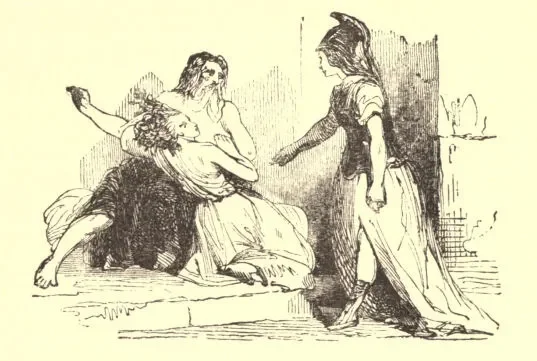
Medusa (plaintiff) vs Athena (defense)
Question: “Was Medusa wronged?”
Context
The story of Medusa, a tale as old as time, is often told as one of transformation. The tale of someone who once was a beautiful maiden, that was then cursed by the goddess Athena and turned into a hideous monster. However, this version of events severely overlooks the injustice at its core.
Medusa was once a dedicated priestess of Athena, the goddess of wisdom, serving faithfully within her temple. Now, Medusa’s beauty and elegance was not one to be overlooked, for it was quick to catch the eye of Poseidon, god of the seas. As many different gods would attempt to court this gorgeous maiden, Poseidon was no different.
After Medusa’s rejections grew tiresome, Poseidon’s persistence only escalated. In a heat of humiliation, he took to grave lengths to pursue Medusa, following her to the temple of Athena. In an act of unspeakable betrayal, Poseidon violated Medusa in the very temple she dedicated her life to protecting.
Rather than punishing Poseidon, Athena turned her anger towards Medusa. In an act that would define Medusa’s legacy, she transformed her beautiful hair into vicious snakes, cursing her and condemning her to a life as a monster feared and hunted by all.
Now this case raises a critical question: Was justice served, or was Medusa wrongfully punished for a crime committed against her?
Plaintiff argument: (Medusa)
Today here, Medusa argues that she was an innocent maiden who was violated against her own will and then was forced to suffer unjust punishment. As a devoted priestess of Athena, goddess of wisdom, she dedicated her entire life to upholding the sanctity of her temple. The violation of her that she endured at the hands of Poseidon was unwarranted and was not an act of her choosing but a violation of her body that was forced upon her.
Despite this, Athena still directed her anger, rather than her perpetrator, and cursed Medusa to a life as a monster, feared by all. By transforming her into a monster Medusa would be forced to live in isolation. It is here today that Athena is called out for her acts of injustice, punishing the victim rather than delivering the justice that is deserved.
Medusa contends that this punishment that was inflicted upon her, on top of the violation of her rights and body, was not only disproportionate, but fundamentally unjust. Not only did it severely undermine her lack of agency, but it also acted as the leading cause for her lifelong suffering and pain, all for an act she did not commit. Today we ask to bring justice to this victim and find Athena guilty on all accounts.
Defense argument: (Athena)
Athena argues in response, that her actions were not intended as a punishment of Medusa, but rather as a necessary response to the desecration of her sacred temple. Athena states today that as goddess of wisdom, and protector of her domain, her actions only reflected her responsibility and obligation to protect and uphold the sanctity of her space.
In some interpretations, Athena’s transformation of Medusa can be seen not solely as a curse, but as a form of protection. This power that Medusa now holds can allow her the power to defend herself against future harm. By turning her gaze into a weapon, Medusa was no longer vulnerable in the same way she once had been.
Furthermore, the actions of the gods often operate beyond human standards of justice. Athena argues today that her response only reflected her divine order rather than human morality, and thus her actions and decisions can not, and should not, be judged entirely by mortal expectations. Taking this into consideration, we ask you today to find Athena not guilty on all accounts
Now as the people, we want you to decide the verdict. Answer the poll below and tell us your opinion!
